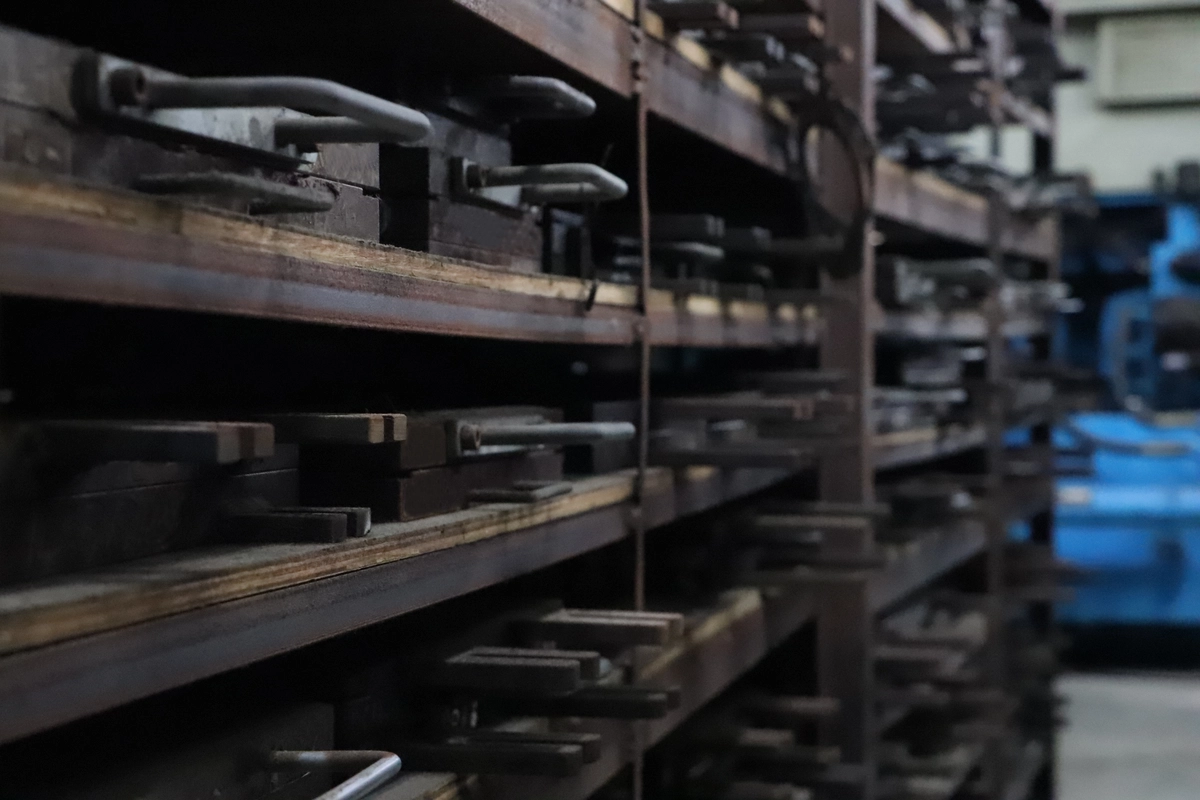
Gasket Manufacturing Lab

Gasket manufacturing racks inside a production facility

THE WORK BEHIND THE PART

WHERE EVERY GASKET GOES THROUGH REAL HANDS, REAL CHECKS, AND REAL PROCESS

Behind every MJ gasket is more than material and machinery. From steel gasket handling to rubber gasket forming, each step involves trained hands, controlled equipment, and repeated checks to make sure the final part is ready for real industry demands.

FIVE STAGES, ONE STANDARD

ONE SEQUENCE
BEFORE EVERY
PART IS CLEARED
TO SHIP.

Whatever the material — steel, rubber, or bonded metal — every part moves through the same sequence before it's cleared to ship.

01

MATERIAL SELECTION

Raw materials and compounds are selected to meet the required specifications before production begins.

02

FORMING / CUTTING

Stamped, extruded, molded, or die-cut into shape, with dimensions controlled from the first piece to the last.

03

TRIMMING / FINISHING

Flash, burrs, and rough edges are carefully removed to achieve a clean, consistent finish, with detailed hand finishing where needed.

04

SURFACE CHECK

Surface coating, finish, and texture are inspected under consistent lighting and compared with the approved reference sample.

05

DIMENSIONAL INSPECTION

Final measurements and fit are verified before the part is cleared for packaging.

FROM STEEL SHEET TO FINISHED GASKET

STEEL GASKET
MANUFACTURING

A die can stamp a steel blank in under a second. But turning that blank into a steel gasket takes more than the press stroke alone.

Stack of steel gaskets

Formed, measured, checked, then released.

After forming, the gasket profile and embossment are verified with precision measuring equipment and checked against the reference sample to confirm the shape is correct. The coating gets the same treatment: checked for evenness under consistent light, not just confirmed as applied.

Only after these checks are completed does a steel-core gasket move on to the next stage.

Forming Precision

01

FORMING PRECISION

An embossment concentrates clamping force into the sealing area, but its height has to be formed within a very narrow tolerance. A few microns too shallow and pressure leaks past; too deep and the steel can deform under load. Each embossment is produced with precision tooling and verified with precision measuring equipment before release.

Layer Assembly

02

LAYER ASSEMBLY

Multiple steel layers are precisely stacked and aligned to build the gasket structure required for each application. Keeping every layer in position throughout the assembly process requires dedicated tooling and manufacturing control before the gasket becomes a single component.

Coating Control

03

COATING CONTROL

Common coatings used on steel gaskets include MoS₂ and silicone-based coatings. MoS₂ reduces friction where layers move in service, while silicone-based coatings help seal microscopic surface irregularities. Uniform coating thickness is just as important as coating selection, so the coating process is controlled to achieve consistent coverage across every gasket.

Material Bonding

04

MATERIAL BONDING

A sandwich-type gasket combines outer steel layers with a graphite or non-asbestos filler. Different materials must be accurately bonded and assembled into a single structure so they perform together under pressure and temperature.

Need Help with Steel Gaskets?

TALK TO OUR TEAM

FROM RUBBER COMPOUND TO FINAL FIT

RUBBER GASKET
MANUFACTURING

Rubber hides its mistakes well until it is installed. A seal can match the drawing and still fail to fit the mating surface, because rubber responds differently during molding and curing.

Rubber gasket being finished

The drawing defines the target. Actual fitment confirms the result.

Rubber prototypes are refined through repeated trials until they match the intended dimensions. Then the gasket is fitted against the genuine mating part, such as an oil pan, valve cover, or heat exchanger plate, to verify the sealing surface before production begins.

Rubber compound profile

01

COMPOUND RATIO

Base polymer, fillers, and curing agents are weighed to a formula, not eyeballed. Shift that ratio even slightly and hardness, heat resistance, and chemical compatibility all shift with it — sometimes in ways that only show up months into service.

Rubber sealing bead

02

RUBBER SEALING BEADS

A raised sealing bead concentrates clamping force into a narrow contact line instead of spreading it across the whole gasket face. Bead profile and height are held to the same rigor as a steel embossment, the material is softer, but the tolerance isn't.

PTFE-coated rubber ring

03

PTFE COATING

A PTFE surface layer keeps the gasket from bonding permanently to the mating flange and adds a layer of chemical resistance the base rubber doesn't have on its own. Coverage is checked for evenness — a thin spot defeats the purpose of coating it at all.

Looking for a Better Sealing Solution?

Let's Solve It

FROM SEPARATE MATERIALS TO ONE COMPONENT

METAL BONDED
WITH RUBBER
MANUFACTURING

Bonding rubber to metal is more than placing two materials into the same mold. The bonding process, molding conditions, and material flow all have to be carefully controlled.

Metal gasket core used for bonded manufacturing

Good molding creates the shape. Controlled bonding makes it last.

Before production moves forward, every bonded part is checked to confirm the rubber is firmly bonded, the molding is complete, and the finished profile meets the intended shape.

Unacceptable bonded gasket edge

01

CONTROLLED MOLDING

Rubber flow during molding must be carefully controlled to ensure complete filling while minimizing excess flash. Consistent molding conditions help produce clean edges, stable bonding, and uniform part quality before the finishing process begins.

Acceptable precision-finished gasket edge

02

PRECISION EDGE FINISHING

Any remaining flash is carefully removed to achieve a clean edge without affecting the bonded rubber. Areas that cannot be finished by standard processes are carefully trimmed to preserve the intended profile and ensure a consistent sealing surface.

Have a Drawing, Sample, or Problem to Solve?

Send Your Inquiry

QUALITY CONNECTION

FROM MANUFACTURING LAB
TO QUALITY LAB

MANUFACTURING LAB QUALITY LAB

Manufacturing is where a part takes shape. Quality is where that work is verified. After leaving the Manufacturing Lab, every new development moves into the Quality Lab for dimensional measurement, material verification, and functional inspection.

Building the part correctly is only the first step. Confirming it meets the required standard is what turns a prototype into a production-ready part.

MJ GASKET - Professional Aftermarket Gasket Manufacturer

Founded in Taiwan, MJ GASKET is a professional aftermarket gasket manufacturer and sealing solution provider, serving global customers across industrial, marine, pickup truck diesel, and hydraulic applications.

With years of industry expertise and a strong focus on quality, MJ GASKET is committed to delivering dependable aftermarket sealing solutions that meet the needs of professional distributors, engine builders, and industrial partners worldwide.

Explore our full range of gasket products and feel free to Contact Us for support or cooperation opportunities.

CONTACT FORM